The Reinforcement Loop
Deployment is not the end of the pipeline — it is the start of a continuous cycle. Production evidence feeds evaluations, Arch analysis, reviewable patches, and promotion gates. The platform harness stays constant while models, tools, and workflows improve underneath. Each stage produces a defined output that feeds the next:
Each approved patch is deployed to production, generating new traces that feed the next iteration.
How the Loop Closes
When Arch detects a degradation, a coverage gap, or a routing inefficiency, it:- Reads trace events directly from the platform runtime — no separate session or manual trigger required.
- Forms a root-cause hypothesis from the trace evidence.
- Proposes a change as a reviewable diff: ABL, prompt, tool binding, policy, or eval.
- Submits the patch for compiler validation before a developer reviews the diff.
Design Principles
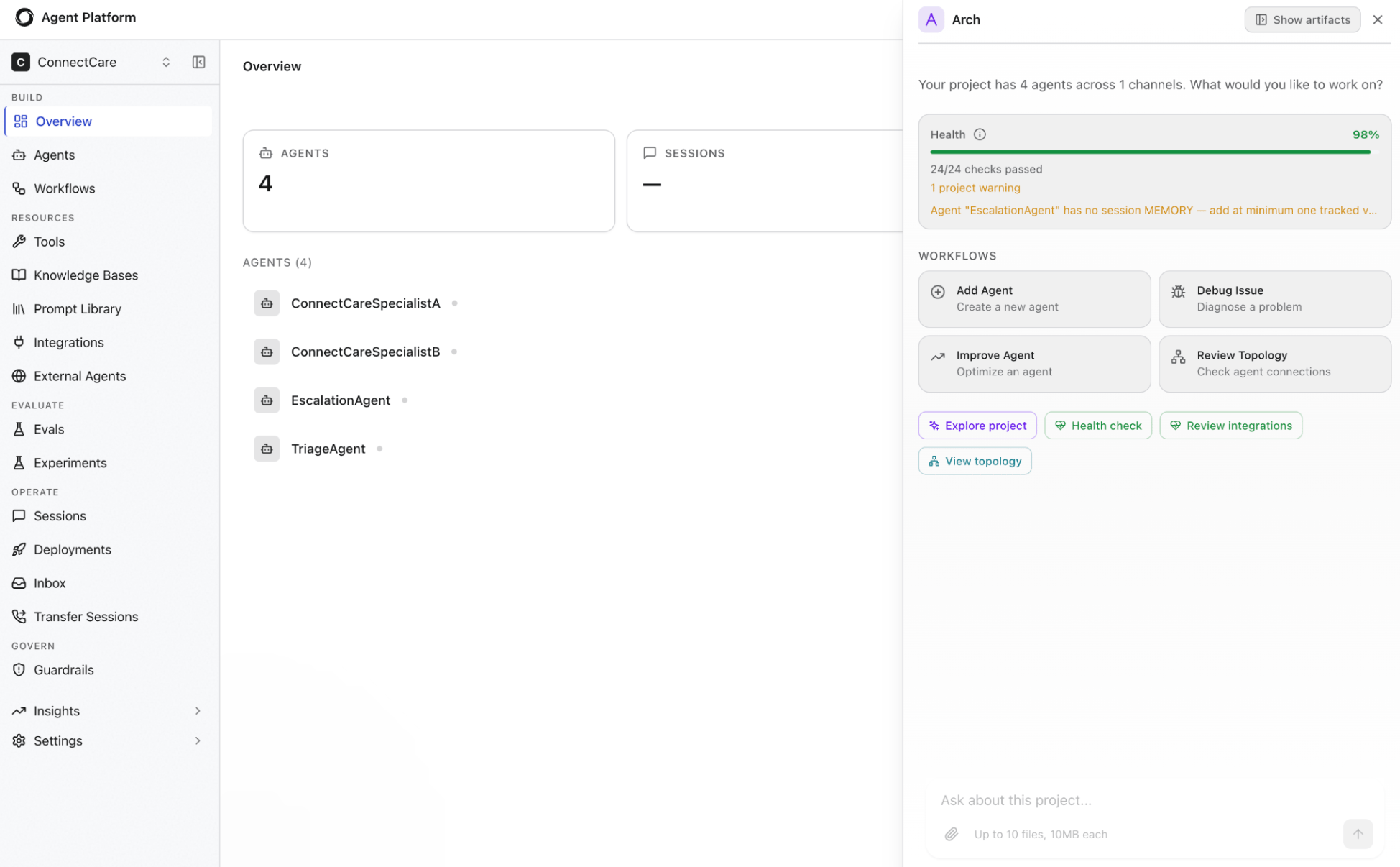
The reinforcement loop is designed around three characteristics that make continuous improvement sustainable at scale.Arch in the Project Sidebar
Arch lives in the project sidebar — available throughout the agent lifecycle, not just during authoring. From the sidebar, you can monitor project health, act on recommendations, and trigger workflows without context-switching.